Published: 10 Nov 2025 | Updated: 5 Jan 2026


Ever wondered whether European roulette is truly random or if the odds might be stacked against you?
Concerns like these often appear in online discussions and forums, where some players question whether live or digital roulette tables are fair. These represent user opinions, not evidence.
In this guide, we’ll look at how regulated online roulette operates, what safeguards exist, and how to recognise signs of unlicensed or manipulated play.
You’ll also learn:
- The four most common indicators of an unfair or rigged roulette game
- How legitimate live roulette providers are monitored
- Why licensing and random number testing matter for every online casino player
- What actions to take if you suspect wrongdoing
|
Disclaimer: This content is for educational purposes only. It does not promote gambling or imply influence over outcomes. Roulette results are determined entirely by chance. Always play on UK-licensed casinos and visit BeGambleAware.org for safer gaming advice. 18+ |
What “Rigged” Really Means in Roulette
In online forums, accusations that casino games are “rigged” usually reflect frustration with losing streaks, not verified manipulation. A rigged roulette game is one that fails to follow true random probability, either by altering wheel balance, software algorithms, or payout ratios.
However, in UK-licensed casinos, both table and card games like roulette are independently audited and certified under strict UK Gambling Commission (UKGC) rules. These include statistical testing, physical wheel calibration, and oversight of all live dealer studios.

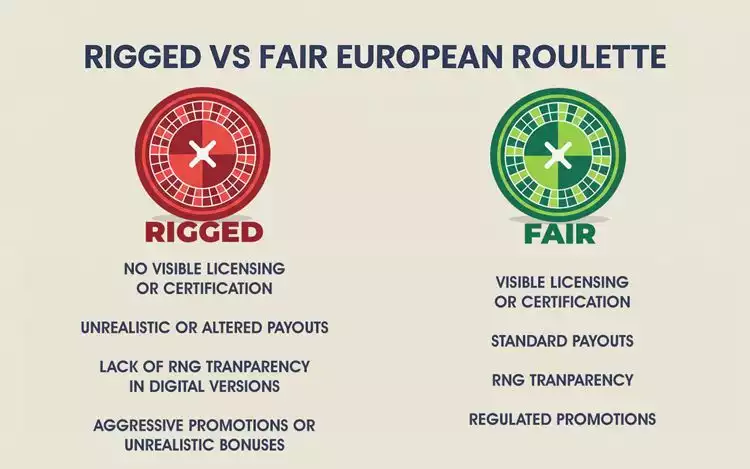
4 Key Signs of Unfair or Unlicensed Roulette Sites
While licensed operators such as Prime Casino must meet rigorous standards, not all sites follow the same rules. Here’s how to identify possible warning signs:
1. No Visible Licensing or Certification
Every legitimate operator lists a licence number—usually from the UKGC or Malta Gaming Authority—at the bottom of their homepage. Sites without one may not be subject to fair play audits or dispute mechanisms.
A trustworthy roulette room will also display verification logos from independent testing agencies like eCOGRA or iTech Labs, which confirm the RNG (random number generator) passes unbiased performance checks.
2. Unrealistic or Altered Payouts
European roulette’s standard payout is 35:1 for straight bets. Any online roulette table that advertises significantly higher multipliers (without transparent terms) should be treated with caution.
You can learn more about expected payout ratios and fairness by reviewing this detailed guide to roulette house edge, which explains how casinos maintain predictable long-term returns—without manipulation.
3. Lack of RNG Transparency in Digital Versions
When playing RNG-based versions (as opposed to live roulette streamed from a real wheel), ensure the software lists its testing provider. Games developed by reputable providers use certified RNGs reviewed by the UKGC and third-party labs.
If this information is missing or the casino cannot verify its supplier, it’s best to exit and stick to licensed live casino platforms that publish clear audit information.
4. Aggressive Promotions or Unrealistic Bonuses
While special offers can be appealing, promotions that promise guaranteed wins or “system-proof” betting results often appear on unregulated sites. Such claims are non-compliant under UKGC/CAP rules. Always confirm that any bonus or cashback offer follows UK advertising standards and is available only through verified operators.
How Regulation Protects Players
UK-licensed casinos—including Prime Casino’s online roulette platform—are required to meet independent audit standards that prevent tampering. Every spin outcome, whether on a mobile app or desktop browser, must meet statistical fairness expectations set by the UKGC.
The UK Gambling Commission’s Testing Strategy outlines periodic compliance checks to ensure RNG accuracy and physical wheel balance (UKGC, 2024). Similarly, eCOGRA certifies that payout percentages (RTP) align with published data through regular game sampling.
If you prefer immersive play with transparent camera angles, live roulette studios offer visible results in real time. These are operated under strict production supervision—each camera feed is stored for audit, ensuring no bias or intervention occurs.
Fact vs. Fiction – Why the “Rigged” Myth Persists
Player frustration often fuels myths about manipulation. In reality, the house edge in roulette already guarantees profit over time without requiring cheating. As explained in Why the Single Zero Reduces the House Edge, the European wheel’s 2.7% edge is simply built into its design. Unlicensed sites exploit this misunderstanding, spreading myths to lure users with promises of “better odds.” To explore common misconceptions further, visit our Popular Myths About European Roulette article.
What to Do If You Suspect a Rigged Game
Repeating number clusters do occur naturally in random games and do not indicate manipulation. If you notice discrepancies such as payout errors, take the following steps:
- Stop wagering immediately and record relevant data (screenshots or spin IDs).
- Verify the casino’s licence number through the UKGC public register.
- Contact the operator’s support team; all regulated sites must maintain a dispute resolution partner.
- If unresolved, file a complaint through ADR (Alternative Dispute Resolution) providers listed by the UKGC.
Learning structured play habits can also improve your awareness of statistical variance. To understand safe methods, refer to our educational piece on best roulette strategy, which explains how probability, not pattern prediction, determines outcomes.
Responsible and Safer Play
Remember that even verified platforms are designed for entertainment, not consistent financial gain. Setting limits, tracking sessions, and using the self-exclusion tools available can help maintain healthy and responsible play habits. Explore licensed games using platforms which support regulated play across mobile devices.
Conclusion – Regulated Systems and Transparent Standards
When it comes to European roulette, fairness is defined by regulation, not promises. Licensed casinos operate within measurable, inspected frameworks designed to keep the game transparent and consistent. Unlicensed platforms, on the other hand, often hide behind secrecy or unverifiable claims.
Key takeaways:
- Legitimate sites disclose RNG testing, payout ratios, and licence details.
- Claims of rigging typically reflect misunderstanding of the house edge.
- UKGC and eCOGRA audits ensure roulette outcomes remain random.
Players should choose only UK-licensed operators, such as Prime Casino, and use responsible gaming tools at all times.