Published: 10 Nov 2025 | Updated: 27 Jan 2026


Roulette is more than just a spinning wheel — it’s a story of evolution, culture, and probability. Two versions, French roulette and American roulette, highlight how one game can take on distinct personalities across continents.
The French version, known for its elegance and protective rules, favours patience and structure. The American version, bold and fast-paced, adds a twist that changes everything — the double zero (00).
In this article, you’ll discover:
- How the double zero shaped the American variant.
- The rules that make French roulette uniquely player-friendly.
- What these differences mean for your odds and playing style.
Whether you enjoy online roulette or prefer the excitement of a live casino, knowing the contrast between these two wheels helps you make more informed choices — and appreciate roulette’s rich history even more.
|
Disclaimer: This article explains features of French Roulette for informational purposes only. It does not provide advice, predict outcomes, or suggest that any approach can influence results. All roulette outcomes are determined by chance using certified RNG systems or audited live wheels. 18+ | Play responsibly. Support at BeGambleAware.org. |
A Tale of Two Wheels — From France to Las Vegas
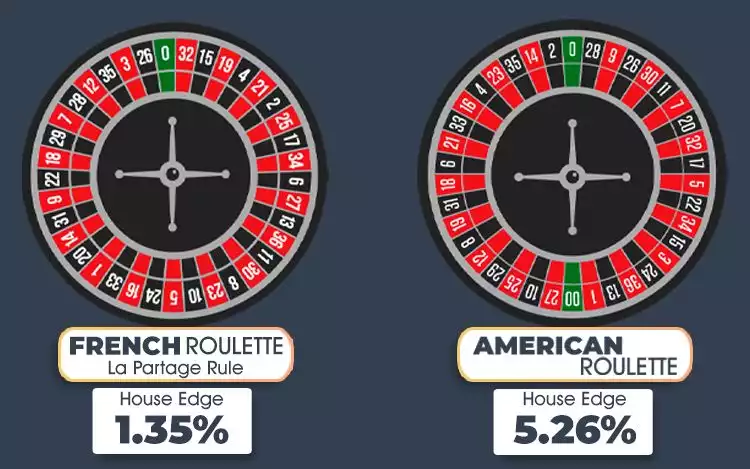
Roulette’s story begins in 18th-century France, when early versions of the game featured both a single zero (0) and a double zero (00). By 1842, the French brothers François and Louis Blanc redesigned the wheel, removing the double zero to create the single-zero format that lowered the house edge and favoured players.
That new design spread across Europe, forming the basis of French and European roulette.
But when the game crossed the Atlantic to New Orleans in the mid-1800s, American gambling houses made a fateful business decision — they brought the double zero back.
The added pocket increased the casino’s advantage and became the hallmark of American roulette, soon found in riverboat casinos and, later, the bright lights of Las Vegas.
Today, both versions share the same principle — predicting where the ball lands — but the way each treats that zero makes all the difference.
Wheel and Layout Comparison
To understand the impact of the extra pocket, let’s place the two versions side by side:
|
Variant |
Pockets |
House Edge |
Distinct Features |
|
French Roulette |
37 (1–36 + 0) |
1.35–2.70% |
La Partage, En Prison, French table terms |
|
American Roulette |
38 (1–36 + 0 + 00) |
5.26% |
No sharing rules, faster pace, bold gameplay |
While both versions feature the same 36 red and black numbers, American roulette includes an additional green pocket (00) opposite the single zero. This seemingly small change increases the house edge from approximately 2.70% to 5.26%.
As a result, many experienced players tend to favor single-zero formats for their lower edge, while others may opt for the double-zero version due to its distinct structure and pacing.
For a deeper look at these statistics, visit the roulette house edge guide.
Rules That Change Player Outcomes
French roulette stands apart for its two unique rules that soften losses and add a sense of strategy to even-money bets:
La Partage Rule
If the ball lands on zero, players lose only half of their even-money bets (Red/Black, Odd/Even, High/Low).
The other half is returned immediately, lowering the effective house edge on those bets to 1.35% — one of the lowest in all casino gaming.
En Prison Rule
In some French tables, even-money bets that hit zero are “imprisoned” for one more spin. If the next result wins, the entire stake is returned.
These player-friendly rules are absent from American roulette. In the U.S. version, when the ball hits 0 or 00, all outside bets lose completely. This structural difference makes the American wheel riskier — and faster — by design.
Strategy and Play Style
While both variants share the same bet types — straight-up, split, corner, or even-money wagers — their rhythm and psychology differ.
- French Roulette: Appeals to disciplined players who prefer structure, etiquette, and a slower tempo. The combination of protective rules and strategic pacing creates a more measured experience.
- American Roulette: Caters to those who thrive on fast decision-making and adrenaline. The double-zero format increases volatility, making big swings — both wins and losses — more common.
For casual players, both can be enjoyed safely through the Prime Casino mobile app, offering both live-streamed and RNG versions with certified randomness under UKGC regulations.
To balance enjoyment and bankroll management, you can also explore the best roulette strategy guide.
Mathematics Behind the Difference
At first glance, both versions seem similar — but their probabilities tell another story.
- In French roulette, the chance of hitting any single number is 1 in 37, giving a return rate of roughly 97.3%.
- In American roulette, it’s 1 in 38, reducing the expected return to 94.74%.
That difference of around 2.56% per spin might not sound like much, but over hundreds of rounds, it adds up to a notable long-term advantage for the casino.
American wheels inherently carry a higher house edge due to the additional green pocket. These characteristics are mathematical properties, not advantages that can be exploited.
Playing in Modern Casinos
Today, both versions thrive in different corners of the world — and online.
- American roulette is common in U.S. venues and in some digital table games format due to its traditional use in those regions.
- French roulette remains popular in European casinos and in premium live dealer studios where traditional layouts and rules are featured.
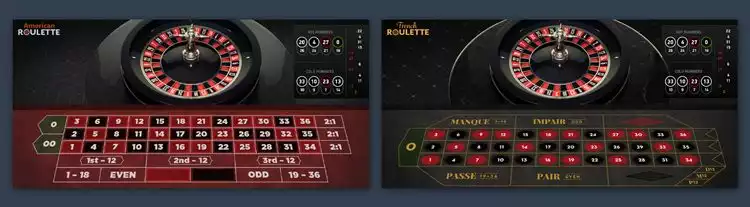
Regulated platforms use audited RNG systems or certified live-dealer equipment. Always review the rules panel of any table to confirm which variant is being played and whether La Partage or En Prison apply.
Players may also encounter general promotions or bonuses, but these do not alter roulette odds and should be used in accordance with responsible play guidelines.
Which Version Should You Choose?
The choice between French and American roulette depends on personal preference rather than advantage.
- Choose French roulette if you prefer a structured, traditional pace and want to play on a single-zero wheel where certain even-money bets may include partial-loss rules.
- Choose American roulette if you enjoy a faster, high-variance experience and prefer the classic U.S. format.
Neither option affects the randomness of the game; they simply offer different environments and pacing.
Conclusion — Two Styles, One Wheel
French and American roulette share the same heart but tell very different stories. One favours fairness and refinement, the other speed and volatility.
Key takeaways:
- French roulette uses a single zero, offers La Partage and En Prison, and has a lower house edge (1.35–2.70%).
- American roulette adds a double zero, raising the edge to 5.26% but delivering a faster-paced, high-stakes feel.
- Your choice depends on preference: precision and patience or risk and adrenaline.
Both remain timeless — proof that even a single pocket can reshape the balance between chance and design.
Experience both styles responsibly and discover your ideal pace at Prime Casino.